

Most Australian homes with rooftop solar are quietly giving away their cheapest electricity. The panels peak between roughly 10am and 3pm, nobody's home, and the surplus goes to the grid for a feed-in tariff that in many states has collapsed to single-digit cents per kilowatt-hour [VERIFY]. Meanwhile the reverse cycle air conditioner - the single hungriest appliance in the house - gets switched on at 6pm when you're buying power back at three to seven times that rate.
The fix isn't a battery. It's timing.
Why the maths works so strongly in your favour
The value of running your aircon on solar isn't the solar itself, it's the gap between what you'd have been paid for exporting and what you'd have paid to import.
As a rough guide for 2025: a typical residential import rate sits somewhere around 30-40c/kWh depending on state, retailer and tariff type, while many feed-in tariffs now sit between 2c and 8c/kWh [VERIFY]. Every kilowatt-hour of solar you self-consume instead of export is therefore worth roughly 25-35c [VERIFY] - not the 5c the export would have earned.
A 7.1kW (cooling capacity) split system usually draws somewhere around 1.8-2.2kW of electrical input at full tilt, and considerably less once it's reached setpoint and the inverter compressor throttles back [VERIFY - check your unit's nameplate and specification sheet]. Run it for four midday hours and you might consume 4-6kWh. Shift that from grid to solar and you're saving roughly $1.20-$2.00 a day [VERIFY], every day you'd have run it anyway.
That's the whole idea. You're not using less energy. You're using the same energy at a much better price.
Pre-cooling and pre-heating: the core tactic
A well-sealed, reasonably insulated Australian home behaves like a slow thermal battery. You can charge it with solar.
In summer: start the aircon around 11am-midday while the array is producing, and pull the house down to 21-22°C rather than the 24°C you'd normally accept. By late afternoon when solar output falls away, the building fabric is already cold and the unit needs far less run time to hold a comfortable temperature through the evening peak.
In winter: the same trick in reverse. Reverse cycle heating is also dramatically more efficient in the middle of the day, because heat pump performance drops as the outdoor temperature falls. Heating at 1pm when it's 16°C outside costs meaningfully less per unit of heat delivered than heating at 7am when it's 4°C - so a solar-timed schedule wins twice.
How well this works depends entirely on your building. A double-brick or well-insulated home with decent window coverings might hold pre-cooling for four or five hours. A 1970s brick veneer with single glazing and no ceiling insulation top-up may bleed it in ninety minutes. Test it before you commit to a schedule: set a temperature logger in the living area and watch how fast the room drifts back after the unit stops.
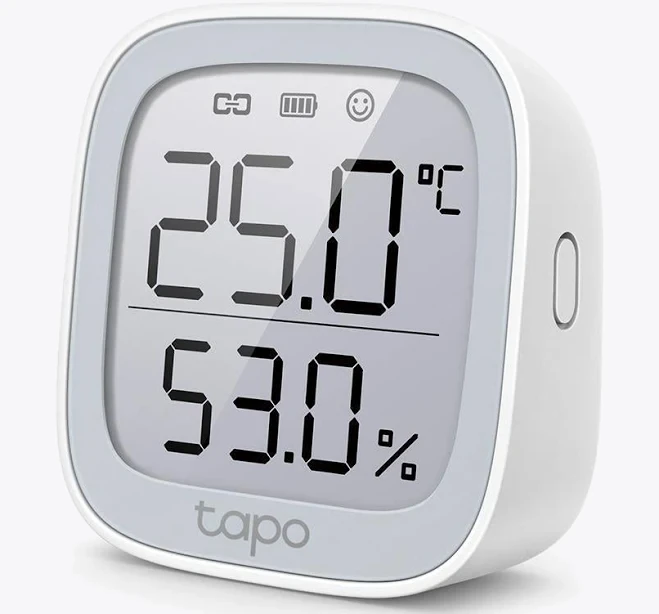
TP-Link Tapo Smart Temperature & Humidity Monitor
Also stocked at: The Good GuysAmazon AU
Getting a smart controller onto a dumb split system
Most split systems in Australian homes have no cloud connectivity at all - just an infrared remote. An IR bridge controller solves this without touching the wiring, which matters enormously if you're renting.
These devices sit in line of sight of the indoor head unit, learn its IR command set, and expose the aircon to your phone, to voice assistants, and critically to schedules and automations. Sensibo's controller is the most established option in this category and includes its own temperature and humidity sensing, plus geofencing and climate-based scheduling.

Sensibo Air Smart Air Conditioner Controller
Also stocked at: Amazon AU
Budget Tuya-based IR thermostats do much the same job for a fraction of the price and work with Smart Life and Home Assistant. They're generally less refined - state tracking can drift, because IR is one-way and the controller only knows what it last sent, not what the unit is actually doing.

Tuya Smart Wifi IR Air Conditioner Controller Thermostat
A note on plug-in smart switches: don't try to control a split system with a standard 10A smart plug. Reverse cycle units are typically either hardwired or on a dedicated 15A circuit, and cycling power at the plug is a poor way to control a compressor anyway. Any change to hardwired circuits, isolators or dedicated aircon wiring must be done by a licensed electrician under AS/NZS 3000 [VERIFY current edition and your state's requirements].
Triggering on actual solar production, not just the clock
A fixed 11am-3pm schedule is a fine start. Triggering on real export is better, because it survives cloudy days, dirty panels and the days you left the pool pump running.
The approach: measure net grid flow at the switchboard, and only allow the aircon to run its solar-priority schedule when the house is exporting more than, say, 1.5kW. A whole-home energy meter with current transformer clamps gives you that signal in real time.
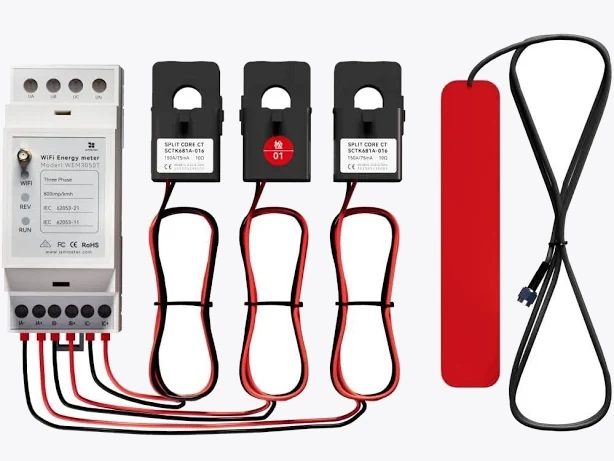
IAMMETER WEM3050T WiFi Energy Meter
This class of device reports per-phase power and direction over Wi-Fi and integrates with Home Assistant, which is where the logic lives. A basic automation looks like:
- If grid export > 1.5kW for 10 minutes and indoor temp > 23°C and time is between 10:00 and 15:30 → set aircon to 21°C
- If export drops below 300W for 15 minutes → raise setpoint to 24°C or turn off
The delay timers matter. Without them, a passing cloud makes your compressor short-cycle, which is hard on the equipment and inefficient.
Important: CT clamps go around live conductors inside the switchboard. In Australia, installing them is electrical work and requires a licensed electrician - this is not a DIY job regardless of what an overseas installation video shows [VERIFY with your state's electrical safety regulator].
If you have a hybrid inverter or battery system, check whether your inverter brand already exposes production and export data to Home Assistant. Fronius, SolarEdge, Sungrow and Enphase all have integrations of varying maturity [VERIFY current support], which can save you buying a separate meter.
What this doesn't fix
Be realistic about the limits.
Evening peaks still cost money. Pre-cooling reduces evening run time; it doesn't eliminate it. On a 40°C Adelaide or Western Sydney day, you'll still be importing after sunset.
Oversized systems behave badly. An aircon much larger than the room needs will satisfy the thermostat quickly and then cycle, which is inefficient and uncomfortable. Solar timing won't rescue a badly specified install.
Export limits apply. Many networks now impose export limits or dynamic export control, and some states have introduced minimum-export or curtailment rules [VERIFY with your DNSP]. Self-consumption becomes more valuable, not less, under those conditions - which strengthens the case here.
Draughts undo everything. Before spending on controllers, spend twenty dollars on door seals and check your ceiling insulation. Pre-cooling a leaky house is like filling a bath with the plug out.
A sensible order to do this in
- Read your last four quarterly bills and find your actual import rate and feed-in tariff. Everything downstream depends on that gap.
- Seal draughts and check insulation.
- Add a temperature sensor in your main living area and log how fast the room drifts after the aircon stops. That tells you how long pre-cooling will hold.
- Add an IR controller and run a simple time-based schedule for two weeks. Compare bills or meter readings.
- Only then invest in switchboard-level monitoring and export-triggered automation.
Steps one to four cost very little and deliver most of the benefit. Step five is for people who enjoy the optimisation as much as the savings - and if you're reading a smart-home site, that's probably you.


