

A second-hand smart plug and a second-hand smart lock are completely different purchases. One is a twelve-dollar gamble on a piece of plastic that either works or does not. The other can arrive still registered to a stranger, still holding their access codes, and still sending them notifications. The category matters far more than the price.
This is what to check before handing over money, and which devices are worth buying used at all.
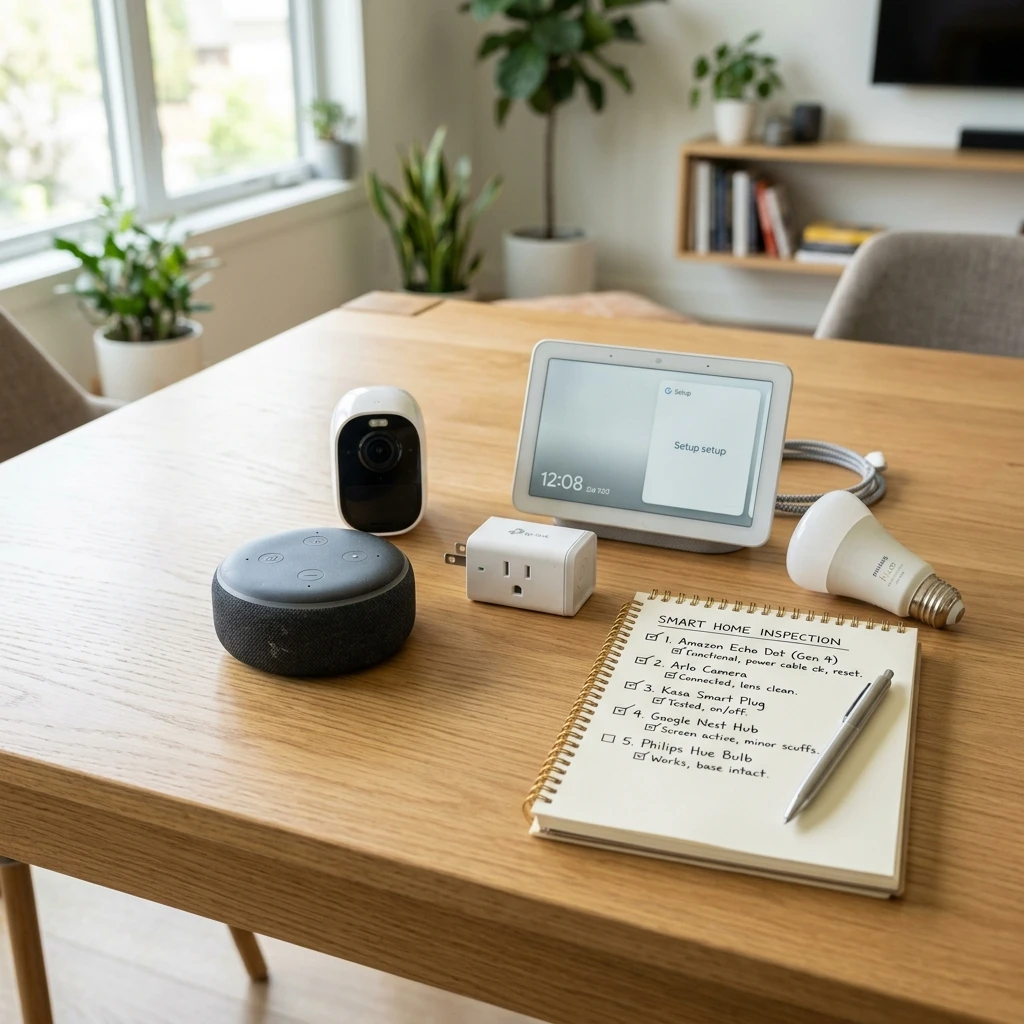
What is worth buying used, and what is not
The dividing line is whether the device holds an identity. A bulb does not care who owns it. A camera does.
| Usually fine | Buy with care | Avoid |
|---|---|---|
| Hubs and bridges | Robot vacuums | Smoke alarms |
| Smart bulbs | Video doorbells | Smart locks from private sellers |
| Smart plugs | Indoor and outdoor cameras | Anything with a swollen battery |
| Door, motion and temperature sensors | Thermostats | Devices with no model number visible |
| Switches and dimmers (unwired) | Speakers with assistants built in | Mains-powered gear with no compliance mark |
Sensors and bulbs are the genuine bargains. They fail rarely, they hold nothing personal, and a factory reset genuinely returns them to new. If you are building out a Zigbee or Thread network, buying sensors used is one of the few places the savings come with almost no catch.
The account lock is the biggest trap
Most connected devices are bound to the account that first set them up. Cameras, doorbells, locks, robot vacuums and many speakers register to the seller's account on a manufacturer's server, and that binding does not live on the device.
This is why a factory reset is not enough on its own. Resetting the hardware clears local settings, but the manufacturer's records may still show the device as belonging to the previous owner. Depending on the brand, you will either be unable to add it to your own account at all, or you will add it and find the original owner retains some access.
Ask the seller to remove the device from their account while you are watching, before you pay. In most apps this is a "remove device", "delete from account" or "transfer ownership" option, and it takes under a minute. A seller who will not do it either no longer has access to the account — which means the device may be unusable — or has not understood the question. Either way the answer is the same.
For anything with a camera or a lock, treat this as non-negotiable rather than a preference.
Check it can legally and safely run here
Used gear is where imported and grey-market stock quietly ends up. Four checks:
- Plug and voltage. Australia runs 230 V nominal with the AS/NZS 3112 Type I plug. A device with a flat two-pin or round-pin plug was not sold into this market, and a travel adaptor does not make it compliant.
- The compliance mark. Mains-powered electrical equipment sold in Australia is expected to carry the Regulatory Compliance Mark. [VERIFY] Its absence on a mains-powered device is a genuine reason to decline, not a formality.
- Bulb fittings. Australian homes use both B22 bayonet and E27 screw. Plenty of imported smart bulbs are E26, which is close enough to look right and wrong enough to matter.
- Wi-Fi band. Most smart home devices connect only on 2.4 GHz. Not a second-hand problem specifically, but the most common reason a working used device appears dead on arrival.
Anything electrical that will be wired into the house rather than plugged in is a separate matter. Fixed wiring is licensed work in every state and territory. [VERIFY] A second-hand smart switch is fine to own; installing it yourself is not a decision to make on the basis of a buying guide.
Where you buy changes what you are owed
This is the part most people get wrong, and it has nothing to do with the device.
Buying from a business — a retailer's refurbished stock, a registered eBay business seller, a manufacturer's own renewed programme — generally brings consumer guarantees with it, including on used and refurbished goods. What counts as acceptable quality is assessed against the age, price and description of the item, so a five-year-old hub is not held to the standard of a new one. [VERIFY]
Buying privately — most Gumtree and Facebook Marketplace listings, and individual sellers on eBay — generally does not carry those guarantees. [VERIFY] If it stops working the following week, you have very little recourse.
That difference is usually worth more than the price gap. For a twenty-dollar sensor, a private sale is a reasonable risk. For a camera you intend to rely on, paying more to a business that has to stand behind it is the better trade.
Confirm the current position with the ACCC rather than relying on this summary — consumer law is exactly the sort of thing that changes without anyone announcing it to buyers.
The invisible expiry date
Every connected device has a date after which the manufacturer stops issuing firmware updates. It is rarely advertised, it is almost never on the listing, and it is the most important thing about a used device that still looks perfect.
A camera or lock that no longer receives security updates is a liability on your network no matter how well it functions. Worse, some devices lose their cloud service entirely when a manufacturer retires a product line, at which point working hardware becomes inert.
Before buying, search the manufacturer's support or end-of-life page for the exact model number — not the product family. A seller cannot fix this one for you, and no discount compensates for a device that stops receiving patches next year.
Batteries and physical wear
Battery-powered sensors and cameras are the most common used listings, and battery condition is the least visible thing about them.
Look for swelling — a battery door that no longer sits flush, or a case with a slight curve to it. That is a reason to walk away immediately, not to negotiate. Rechargeable cells in doorbells and cameras also lose capacity with age, so a device that once lasted three months may now last three weeks. Replaceable batteries are a much safer proposition than sealed ones.
For robot vacuums, the battery and the brushes are consumables and the listing price rarely reflects that. Check whether replacement parts for that model are still sold in Australia before committing.
Before you hand over money
- Seller has removed the device from their account, while you watch
- Exact model number confirmed, and still receiving firmware updates
- Compliance mark present on anything mains-powered
- Australian plug, or a bulb fitting that matches your sockets
- Battery not swollen, and replacements still available
- Original power supply included — third-party replacements are a common cause of failure
- You know whether the seller is a business or a private individual
- The app it needs is still published and still supported
What is not worth the saving
Smoke alarms. These have a limited service life and are subject to specific requirements in Australian homes, including in rental properties. [VERIFY] A used one with an unknown history is a bad trade at any price.
Smart locks from private sellers. The account binding problem applies with the highest possible stakes, and you cannot inspect the internal mechanism. From a business with a returns policy, a refurbished lock is defensible. From a stranger, it is not.
Anything you would be annoyed to replace twice. Second-hand economics only work if the saving exceeds the risk of buying again. For low-cost sensors that is nearly always true. For the device holding your front door shut, it rarely is.
Used smart home gear is genuinely worth buying — just not uniformly. Buy the boring things used and the sensitive things new, and the savings arrive without the problems.


